
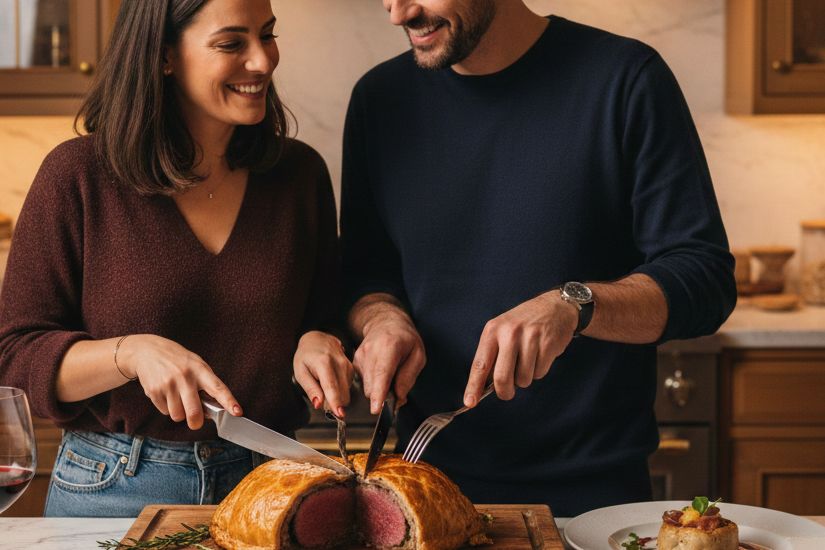
Key Takeaways
TL;DR: A good Beef Wellington comes down to coordination: sear a center-cut beef tenderloin hard, cook the mushroom duxelles completely dry, wrap it in cured ham and puff pastry with chilling at each stage, bake until golden and rest it before slicing.
- Ingredients: About 600–700 g (roughly 1.3–1.5 lb) of center-cut tenderloin for four, trimmed of sinew; duxelles of mushrooms, shallots, garlic and thyme; English or Dijon mustard; Parma ham or prosciutto; and ready-made all-butter puff pastry.
- Sear and duxelles: Sear the dried, seasoned fillet about 2 minutes per side, ends included, brush it with mustard and let it cool completely; cook the duxelles over medium heat for around 20 minutes, until no moisture is left.
- Wrap and chill: Roll the ham, duxelles and beef tightly in plastic wrap and chill for 30 minutes to an hour, then wrap in pastry, seal the edges with egg, brush with egg wash and chill for another 15 minutes.
- Bake and rest: Bake at 425°F (220°C), or 400°F (200°C) in a convection oven, for 25 to 30 minutes, until the center reads 129–135°F (54–57°C) for a pink middle, then rest it uncovered for 10 minutes.
- Mistakes and serving: Skipping the chill, undercooking the duxelles, cutting too soon and using thin pastry cause most failures. Slice with a sharp serrated knife into portions about 1¼ to 1½ inches (3–4 cm) wide and serve with mashed potatoes, broccolini and red wine jus.
Few dishes command the same reverence at a special dinner as Beef Wellington. Golden, flaky pastry encasing a perfectly pink fillet of beef: it is a showstopper in every sense.
But for all its elegance, this dish has a well-earned reputation for being technically demanding. Getting every layer right, at the same time, is where even confident home cooks come undone.
This guide walks you through every stage of how to make Beef Wellington at home, from selecting the right cut to slicing that first confident portion at the table. And once you have mastered it, make it the centerpiece of a formal dinner party.
Índice
Why Beef Wellington is so difficult to get right
The challenge with Beef Wellington is not any single step. It is the coordination of several elements that each demand precision. The beef must be seared hard and fast, then chilled before it touches the pastry.
The duxelles, a finely chopped mushroom mixture, must be cooked completely dry, or it will steam the pastry from the inside. And the puff pastry itself needs to bake hot enough to turn golden before the fillet overcooks.
Timing is everything. A thermometer is not optional. And resting the finished Wellington properly is just as important as cooking it correctly.
Choosing your ingredients
The beef
The fillet of beef, also known as the tenderloin, is the classic cut for Beef Wellington. Look for a center-cut piece that is as uniform in shape as possible, as this helps it cook evenly. For four people, aim for around 600–700 g (about 1.3–1.5 lb). Ask your butcher to trim it of any sinew, as this can cause the meat to bow during cooking.
Quality matters here. Look for beef that has been properly aged, with a deep red color and fine marbling throughout. This is not the dish for a budget supermarket fillet.
The duxelles
Duxelles is a finely chopped mixture of mushrooms, shallots, garlic, and thyme, cooked down until completely dry. Cremini mushrooms work well, though adding a handful of dried porcini deepens the flavor considerably.
The key is patience: the mixture needs to cook over medium heat for around 20 minutes, stirring regularly, until no visible moisture remains.
The wrapping layers
Between the beef and the pastry, you need two additional layers. The first is a thin coating of English or Dijon mustard, brushed onto the seared beef to add flavor and help the duxelles stick. The second is a layer of Parma ham or prosciutto, which wraps around the duxelles to protect the pastry from moisture. Use good quality, thinly sliced charcuterie for the best result.
For the pastry, use a ready-made all-butter puff pastry. Making your own is not necessary and introduces another variable you do not need.
Transform your culinary dreams into reality
From interactive cooking lessons to exotic cuisine adventures, our expert chefs transform your kitchen into a world-class culinary experience.
Step-by-step: how to make Beef Wellington at home
Step 1: Sear the fillet
Pat the beef completely dry with paper towels and season generously with salt and black pepper.
Heat a heavy-bottomed skillet until smoking hot, then add a splash of neutral oil.
Sear the fillet on all sides, including the ends, for around 2 minutes per side. You want a dark, caramelized crust that seals in the juices and adds depth of flavor.
Once seared, brush all over with mustard and leave to cool completely. Do not rush this step. Warm beef will begin to melt the fat in your pastry during assembly, which leads to a greasy, undercooked base.
Step 2: Make the duxelles
Pulse the mushrooms in a food processor until finely chopped, not pureed.
Cook in a wide skillet over medium heat with a little butter, the shallots, garlic, and thyme. Season well. Keep stirring until the mixture is completely dry and begins to look almost paste-like. Spread on a tray and leave to cool.
Step 3: Wrap and chill
Lay a large sheet of plastic wrap on your work surface. Arrange the Parma ham in overlapping slices to form a rectangle roughly twice the length of your fillet. Spread the duxelles evenly over the ham, then place the beef at the near edge.
Use the plastic wrap to roll the ham tightly around the beef, twisting the ends to form a tight log shape. Refrigerate for at least 30 minutes, ideally an hour.
Step 4: Wrap in pastry
Roll your puff pastry into a rectangle large enough to encase the beef log with a little overlap.
Unwrap the chilled beef and place it in the center. Brush the pastry edges with beaten egg, then fold and seal neatly. Place seam-side down on a lined baking sheet.
Brush all over with egg wash and score the top lightly if you wish. Refrigerate for another 15 minutes.
Step 5: Bake
Preheat your oven to 425°F (220°C), or 400°F (200°C) in a convection oven. Bake the Wellington for 25–30 minutes for medium rare until the pastry is deeply golden.
Use a meat thermometer to check the internal temperature: 129–135°F (54–57°C) is the target for a pink center. Leave to rest, uncovered, for 10 minutes before slicing.
Common mistakes to avoid
- Skipping the chill time: warm components will cause soggy pastry
- Undercooking the duxelles, as excess moisture is the enemy of a crisp base
- Cutting too soon: resting is essential for the juices to redistribute
- Using a thin pastry, which will split under the weight of a full fillet
Why many home cooks trust a professional chef instead
Even with the best ingredients and a reliable recipe, Beef Wellington has a habit of exposing the gap between knowing what to do and executing it under pressure. The duxelles can retain moisture. The pastry can split. The beef can overcook by the time everything else is ready.
That is why many people, especially for occasions that matter, choose to book a private chef through Take a Chef. A professional handles every element, from sourcing the beef to plating the finished dish, while you enjoy the evening with your guests.
In the US, a private chef dinner typically costs about $210 per person for one or two guests, dropping to around $150 per person for groups of 11 or more, with menu planning, groceries, cooking, service and cleanup included (see what a private chef costs). It also removes the considerable stress of a technically complex dish and the cleanup.
Serving your Beef Wellington
Classic accompaniments include creamy mashed potatoes, broccolini, and a rich red wine jus. For the jus, reduce a good-quality beef stock with red wine, shallots, and a pat of butter until glossy and deeply flavored.
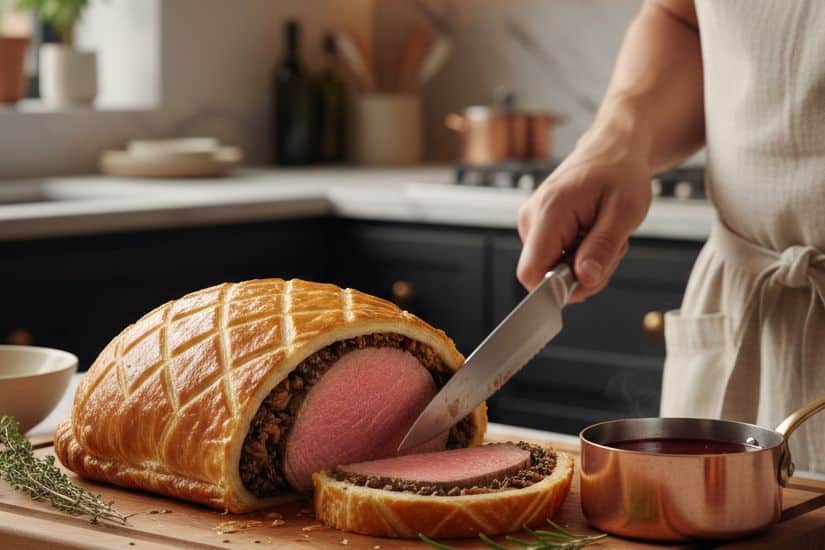
When slicing, use a sharp serrated knife and cut in a single confident motion. Hesitation causes the pastry to crumble. Aim for portions about 1¼ to 1½ inches (3–4 cm) wide and serve immediately. Wellington does not hold well once cut.
However you serve it, Beef Wellington remains one of the great showpieces of British cooking. It delivers on every level: buttery pastry, umami-rich mushroom, salty cured meat, and that perfect blush of pink at the center. Whether you take on the challenge yourself or prefer to leave it to a professional, it is always worth the effort. And if you’re ever in London, see our roundup of the best Beef Wellington in London.