
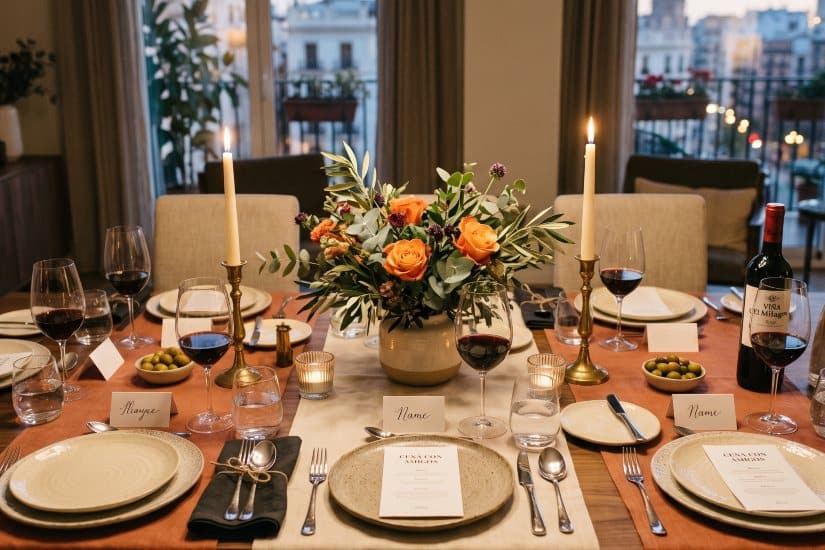
Key Takeaways
TL;DR: Set a dinner party table from the plate outward and in order of use: forks on the left, knives and spoons on the right with the blades facing the plate, glasses above the knives and the bread plate at the upper left.
- The place setting: Center the dinner plate about one inch from the table edge, lay the cutlery from the outside in in order of use, and place the dessert fork and spoon horizontally above the plate, the fork pointing right and the spoon pointing left.
- Casual dinners: One fork, one knife, a spoon if needed, a water glass and a wine glass, a napkin folded into a simple rectangle or roll, and low centerpieces such as candles, herbs or seasonal fruit so conversation flows across the table.
- Formal dinners: Salad, fish and dinner forks on the left; dinner knife, fish knife and soup spoon on the right; a charger plate that’s removed before the main course; and only the glasses you’ll actually use.
- Napkin folds: The roll and the bishop’s hat suit casual tables and take under a minute; the fan and the fleur-de-lis suit formal ones, where the napkin rests on the charger plate or to the left of the forks.
- Finishing touches: Iron the napkins, align everything to a common baseline, polish the glasses, use place cards for six or more guests and allow at least 24 inches (60 cm) of width per guest.
Few details shape the mood of a dinner party more quietly than the table itself. Before a single dish arrives, your guests read the space: the arrangement of cutlery, the fold of the napkin, the placement of glasses. A well-set table signals care and attention, and it makes everyone feel welcome from the moment they sit down.
This guide walks you through how to set a table for a dinner party, whether you are hosting a relaxed Sunday lunch or a formal multi-course evening. You will find guidance on basic place settings, napkin folding, casual and formal arrangements.
Índice
Start with the basics: understanding a place setting
A place setting is the collection of tableware for one guest. Getting the fundamentals right makes every decision easier and gives the table a sense of order.
The plate is the anchor. Position the dinner plate in the center of the space, roughly one inch from the edge of the table. This is called the cover and defines the guest’s personal territory at the table.
Cutlery placement
Cutlery is arranged in order of use, working from the outside in. Forks go to the left of the plate; knives and spoons to the right. The cutting edge of each knife always faces the plate.
For a simple two-course dinner, place a dinner fork and dinner knife directly beside the plate. If you are serving soup, add a soup spoon to the far right. A dessert fork and spoon can sit horizontally above the plate, the fork pointing right and the spoon pointing left.
Glassware
Position the water glass directly above the knife, slightly to the right. Wine glasses sit to its right in order of use, from the outside in like the cutlery: the white wine glass, typically poured first with the appetizer, goes on the far right, and the red wine glass sits between it and the water glass.
Bread plate and butter knife
The bread plate sits to the upper left, above the forks. Rest the butter knife across the plate, blade inward. This small detail elevates an otherwise simple setting.
Unforgettable moments with gourmet touches
From intimate dinners to special celebrations, our private chefs create memorable experiences that turn any event into something extraordinary.
Casual dinner party settings
A casual dinner party calls for a relaxed version of the above. Stick to the essentials: one fork, one knife, one spoon if needed, a water glass, and a wine glass. A linen napkin folded into a simple rectangle and placed on the plate adds warmth without fuss. Charger plates and elaborate glassware are optional. For a complete walkthrough of planning the evening itself, read our Hosting a dinner party guide.
Centerpieces can be more relaxed: a cluster of candles, a bunch of herbs in a low vase, or seasonal fruit. Keep them low so conversation flows freely across the table.
Napkin folding for casual settings
The bishop’s hat fold and the simple roll are both ideal for casual occasions.
For the roll: fold the napkin in half lengthwise, roll it tightly from one end, and secure it with a napkin ring.
For the bishop’s hat: fold the napkin diagonally into a triangle, fold the two outer corners up to meet the top point, then flip and tuck the bottom flap behind. Both take under a minute and look intentional.
Formal dinner party table settings
A formal setting follows stricter conventions but is not as complicated as it appears. The key is layers: each course gets its own cutlery, placed in strict outside-in order, and every element has a designated position. For the etiquette that carries the whole evening beyond the place setting, see our Hosting formal dinners guide.
The formal place setting layout
Working from left to right: salad fork, fish fork, dinner fork (to the left of the plate); dinner knife, fish knife, soup spoon (to the right). The dessert fork and spoon rest horizontally above the plate. A charger plate anchors the setting and is removed before the main course is served.
Glassware multiplies at a formal table. From left to right above the knives: water goblet, champagne flute, red wine glass, white wine glass. Do not crowd the table: serve only the glasses you will actually use.
Napkin folding for formal settings
The fleur-de-lis and the fan fold are classic choices for formal occasions.
For the fan: accordion-fold the napkin widthwise in roughly ¾-inch folds, pinch the center, and open out the top half into a fan shape. Stand it in a wine glass or upright on the plate. It takes about two minutes per napkin and makes an immediate impression.
At a formal setting, the napkin traditionally rests on the charger plate or to the left of the forks. Avoid placing it inside glasses unless your fold requires it: this can look informal and makes the glass awkward to use.
Mastering the details: tips for a polished table
A few finishing touches make a significant difference:
- Iron or steam your napkins. Wrinkled linen undermines an otherwise perfect setting.
- Align everything to the base. Cutlery, glasses, and plates should share a common baseline roughly one inch from the table edge.
- Polish glassware before placing it. Hold each glass to the light and buff with a lint-free cloth.
- Place a small card with each guest’s name to direct seating at dinners of six or more.
- Test your lighting. Candles should supplement, not replace, ambient light during the meal.
Spacing matters as much as arrangement. Allow at least 24 inches (60 cm) of width per guest so elbows do not clash and each course can be served comfortably.
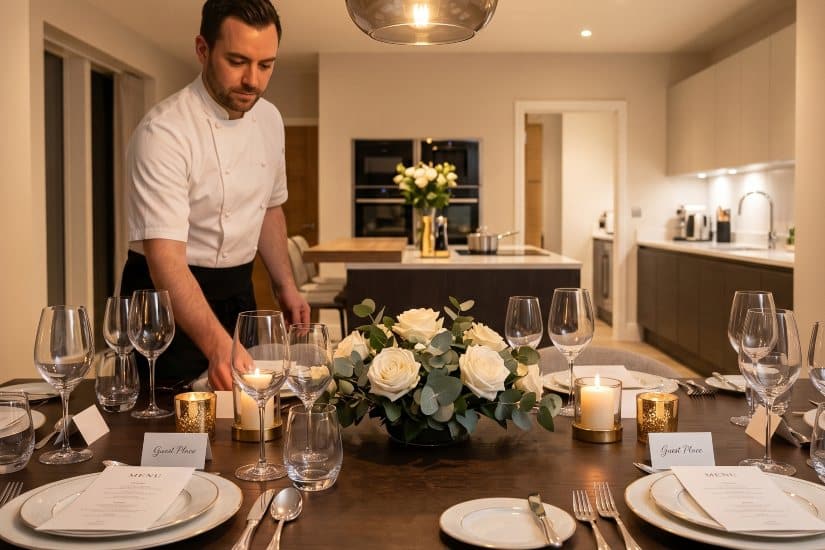
Leave the table to the experts: Take a Chef
Knowing how to set a table for a dinner party is one thing. Managing the full evening, from mise en place to plating, service, and clearing, is another challenge entirely. This is exactly where a private chef transforms the experience.
With Take a Chef, you book a professional dinner chef who comes to your home, handles every element of the meal, and applies fine-dining standards to your personal table.
That includes the service choreography that complements a formal setting: courses brought out in sequence, glassware refreshed at the right moment, and the rhythm of the evening managed so you can be present as a host rather than disappearing into the kitchen.
The platform connects you with vetted chefs across more than 400 cities worldwide. You choose the menu, the occasion, and the level of formality. Take a Chef’s team handles the rest. Explore the private chef for dinner party service to see how it works.
Bringing it all together
Setting a table well is a form of hospitality. It tells your guests that you have thought about them before they arrived.
Whether you choose a pared-back casual arrangement or the full formality of multiple courses and cut crystal, the principles remain the same: start from the plate outward, work in order of use, and attend to the small details others might overlook.
When you want the entire experience to match that level of care, from the first canapé to the final dessert, Take a Chef makes it possible to host without compromising on presence. The table is yours to set; the meal is theirs to perfect.